Points of Accumulation#
The feed that 9 out of 10 teachers* recommend you to scroll
Cuprins#
Algebra = Orthopedics?#
Mathematician Muhammad ibn Musa al-Kharizmi lived in the eighth and ninth centuries and is considered the first algebraist in history. For most of his life, he worked at The House of Wisdom in Baghdad, which had an impressive library and was home to most of the greatest mind of those times. A representation of it can be seen in the picture below, taken from a manuscript dated back to 1237.
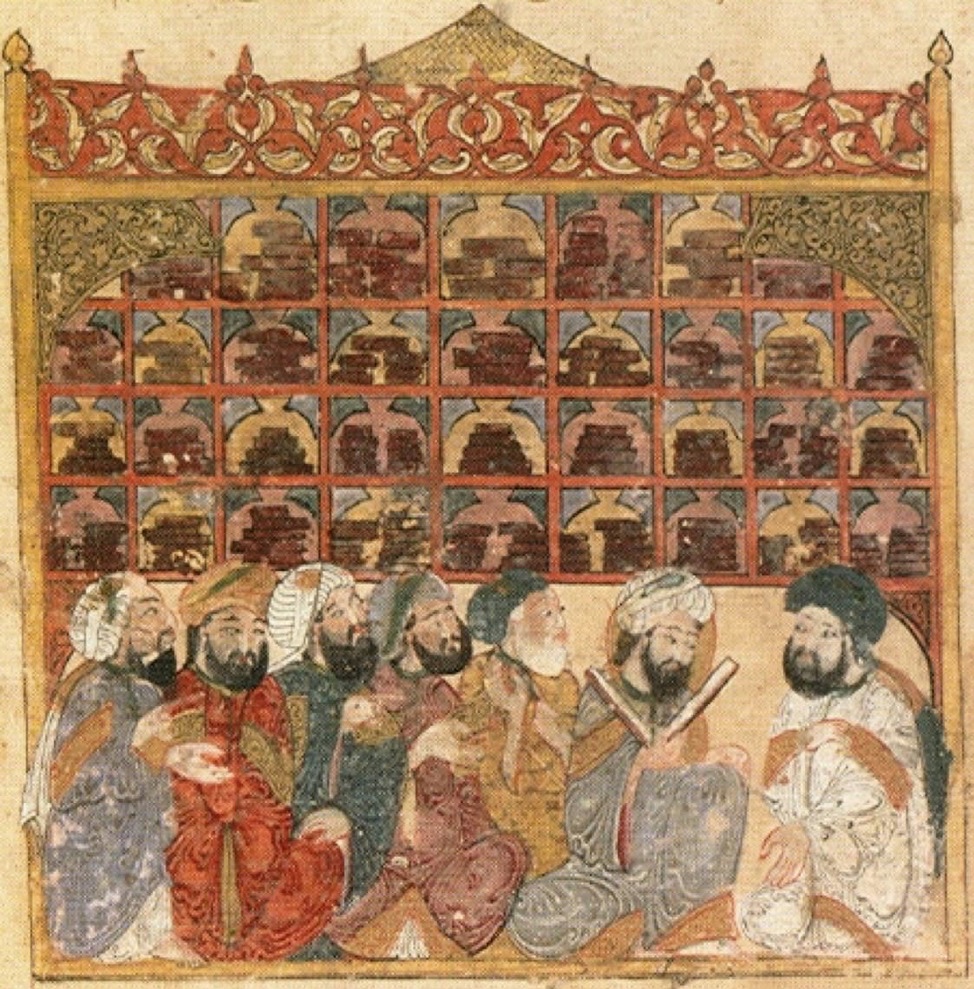
However, solving algebraic equations and complicated arithmetic, which we associate with algebra nowadays, were not pioneered by al-Khwarizmi. Nevertheless, in the year 820, al-Khwarizmi published the treatise al-Kitāb al-Mukhtaṣar fī Ḥisāb al-Jabr wal-Muqābalah, which translates roughly to The Compendious Book of Computation Through Balancing. But what’s important here is that the word al-Jabr appears in its title.
This word got us “algebra”, because even the very first Latin translations of the compendium were titled Liber Algebrae, or The Book of Algebra.
A lesser known information is that al-Kharizmi did not invent this word. Instead, he took it from ancient medicine. There it referred to a type of primitive orthopedics, which was used to realign broken or dislocated bones. Here lies al-Khwarizmi’s idea of “balancing” equations, because in his compendium, one can find the first systematic approach to solving algebraic equations.
The “balanced” form that the mathematician was after was precisely the solution. To find that, he showed that one must apply the inverse operations to those which made the equation in the first place. And this is precisely the method we still use nowadays in elementary algebra:
$$ \begin{align*} 5x - 1 &= 9 & \quad & \mid + 1 \\ 5x &= 10 & \quad & \mid :5 \\ x &= 2 & \end{align*} $$Blue Tigers#

The Argentine writer Jorge Luis Borges (1899-1986) is known for his subtle mathematics, logic, and language that he used in his prose. The volume Shakespeare’s Memory, published in 1983 in Buenos Aires, puts together some of his last short stories.
Among those you will find the Blue Tigers (Tigres Azules), a story which has a distinct intensity, which touches upon themes such as the foundations of mathematics and logic, through an arithmetic paradox.
The main character is the Scotsman Alexander Craigie, a researcher in logic, whose fundamental beliefs were concentrated in two principles:
- Everything in this word is identical to itself, a property known by mathematicians as the reflexivity of identity and
- Two identical things input to the same transformation lead to identical outputs, also known as Leibniz’s identity principle.
How can they not hold? How can one imagine a world where these principles are not true? This is precisely why they are the foundation of arithmetic. Without them, one cannot precisely define 1, then taking the next step to 2, then from 2 to 3 and so on, until defining the full set of natural numbers: 1, 2, 3, 4, 5, 6, 7,…, and so forth, without end.
But natural numbers have one more essential property: they are discrete. That is, between 1 and 2 there is nothing, as between 2 and 3 or any two consecutive natural numbers. Without this property, counting would become impossible, because we can never know what’s next after any one particular natural number.
This is where the culprit of Borges’ story emerges. Craigie ventures into the wild looking for the elusive blue tigers (I’ll let you read what those are), and when he does find them, he is astonished to conclude that they defy the essence of arithmetic: although seemingly finite, as he can pocket them, they are impossible to count.
Read the full story in an English translation here.
Einstein, Gödel, and their Fountain Pens#
In 1921, Albert Einstein is gifted a fountain pen by fellow physicist Paul Ehrenfest: a Waterman Ideal 22, made in France. Here it is below, or you can see it in person at the Boerhaave Museum in Leiden, The Netherlands.
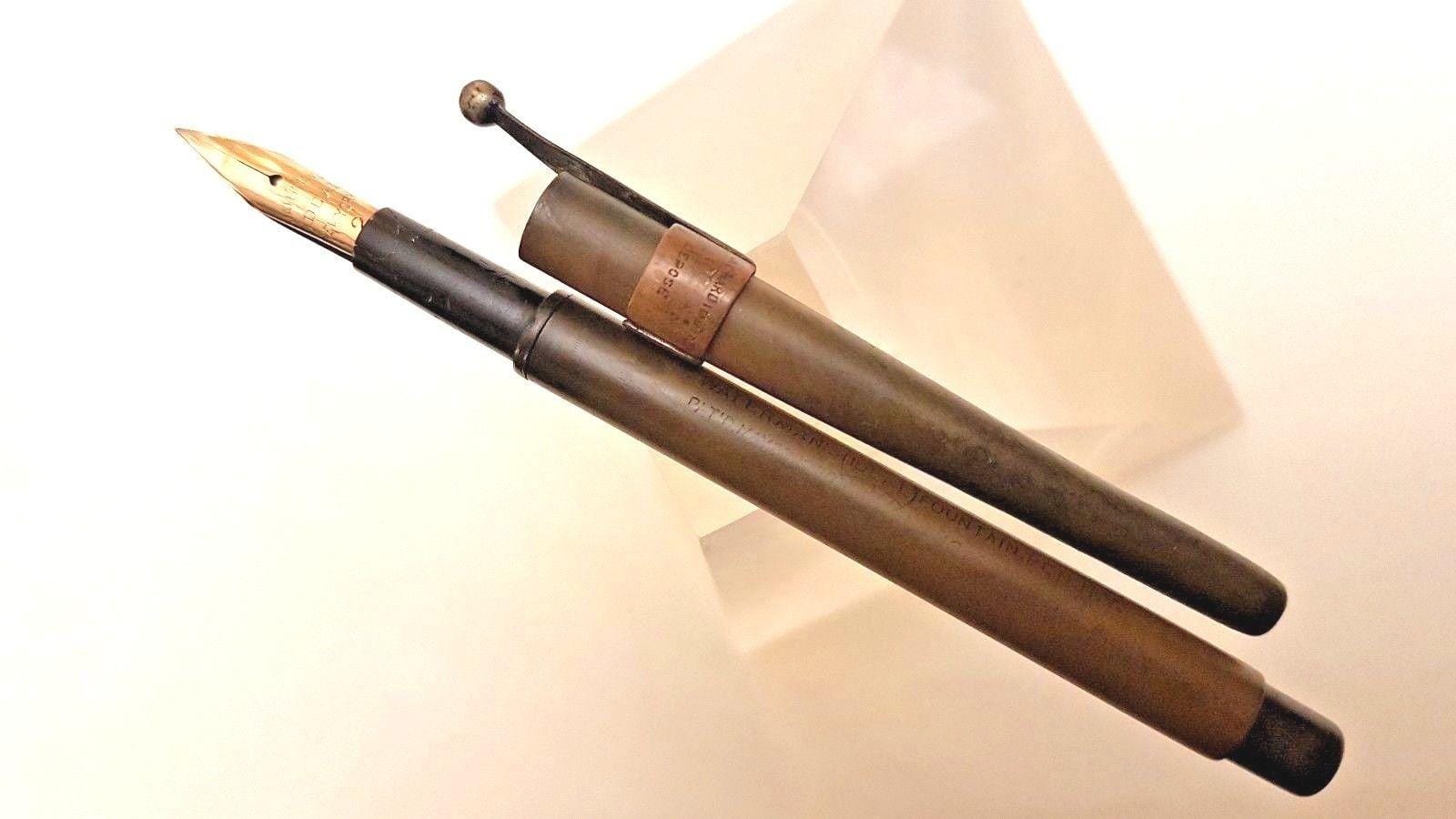
For those times, this was a luxury pen, and the impeccable state it still has shows that the great physicist used it carefully.
Equally interesting is that this is the pen which may have been used to write the famous $E=mc^2$ equation. There are many photographs of Einstein at his desk, while working and writing with his fountain pens (we know he had more than one, some of the others being made in Germany by Pelikan). However, more than a century ago, image sharpness was not great, and also fountain pens were not that different in design to be able to pinpoint the exact model he used. Nevertheless, Ehrenfest’s gift, which he received the very year when he was awarded the Nobel Prize, was certainly used in writing many equations which changed physics forever.
Equally revolutionary was Austrian Kurt Gödel’s work in logic, which specialists claim brought the most changes in logic since Aristotle. Gödel proved the famous incompleteness theorems, which impose on mathematics one of the two limitations:
- either it could answer all questions ever, but sooner or later there will appear contradictions, namely questions which can be proved both in the affirmative and in the negative, none of which can be shown to be wrong,
- or it will never face such contradictions, but there will be questions where the answer is demonstrably impossible to find.
From native Austria, Gödel moved to the US, where for some years, he worked with Einstein at the Institute for Advanced Studies in Princeton. They enjoyed each other’s company, as recounted in letters, diaries, and memoires, so much so that they could be seen walking and talking together in the IAS park, moments which, they recount, were the highlights of their days.
Referring to Gödel’s fountain pens, however, the US was not kind. In 1949, he wrote home:
“P.S. My ugly handwriting is due to losing my old fountain pen, and the new one is good for nothing, because I wanted to save money and bought one for $1.50. I keep losing my pens and I would get very angry if they were expensive.”
Gödel’s correspondence was heavily checked and censored during the second World War and, although he tried multiple times mailing a pen to his mother, it’s not until 1954 that one package reaches the destination. Kurt had sent “a new model, which draws ink through its nib”, presumably the Sheaffer Snorkel, a model produced and sold between 1952 and 1959.
Mother Matrix#
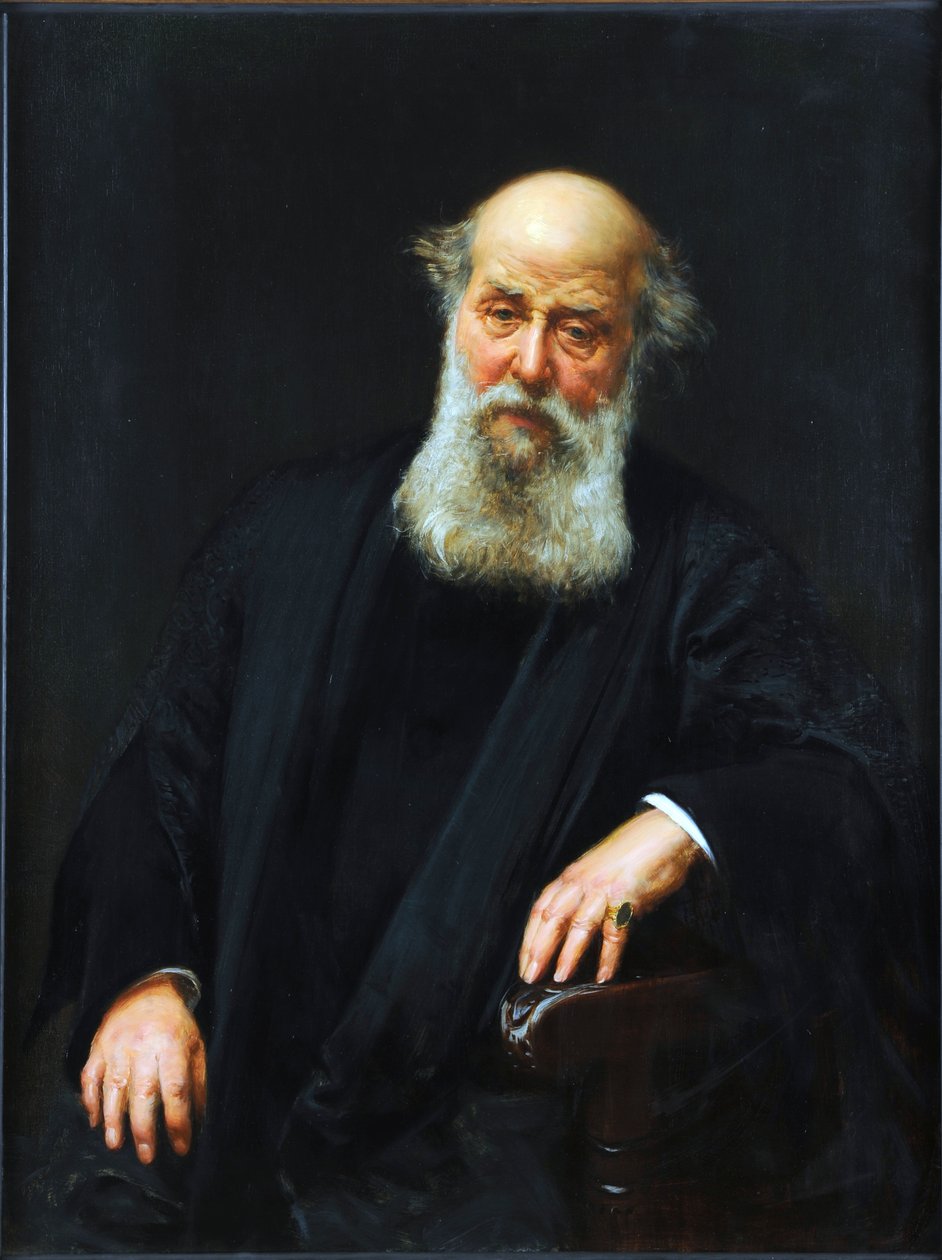
In 1850, mathematician James Joseph Sylvester (pictured below) wrote a treatise on determinants and their properties. Among those, the general method for computing determinants using expansions by elements along a line or column. Like, for instance:
$$ \begin{vmatrix} 1 & 2 & 3 \\ 4 & 5 & 6 \\ 7 & 8 & 9 \end{vmatrix} = 1 \cdot \begin{vmatrix} 5 & 6 \\ 8 & 9 \end{vmatrix} - 2 \cdot \begin{vmatrix} 4 & 6 \\ 7 & 9 \end{vmatrix} + 3 \cdot \begin{vmatrix} 4 & 5 \\ 7 & 7 \end{vmatrix} $$This is the point where Sylvester names determinants Matrix (plural Matrices), a word he took from Latin, where it means birthing mother. The mathematician doesn’t explain how he came up with that word, but a possible interpretation is that determinants have an interesting property: they product self-similar objects when computed (expanded as above). These objects were later called minors, to keep with Sylvester’s naming scheme.
Currently, mathematics draws a clear distinction between matrices and determinants, but in Sylvester’s treatise, the main use of matrices was to compute their determinants, hence the inclination to see the latter as a substitute for the former.
What Is an Unknown?#
When solving an equation, you almost automatically think of the unknown as $x$, right?
But why? How did this remote letter of the alphabet get this status?
In the history of mathematics, equations were usually expressed through practical applications. Until the seventeenth century, when French mathematicians René Descartes and François Viète introduced and used systematically the algebraic notation for equations, such problems were usually formulated with geometric interpretations or even in a narrative form.
$x^2$ represented an area, $x$ was a length and so forth, such that some letters between mathematicians contained “explained” problems such as “three fields and five lengths are 7 square kilometers”.
This imaginary formulation refers to the equation $3x^2 + 5x = 7$, but there are more abstract notations that we currently use and which are surprisingly recent in their introduction and use in mathematics.
It’s not until the sixteenth century that a notation appears, one which resembles, more or less, what we use today. It is found in a book from 1557 by the Welsh mathematician Robert Recorde, pictured below. The very symbol we use for equality was not widespread and it is thought that Recorde introduced that as well, calling parallel lines as the most fitting to represent equality, since they are “perfectly equal”.

But before Recorde, when wise men of Antiquity wanted to formulate an abstract problem, which does not necessarily have a practical application and was not inspired by economy, they resorted to words which meant general items, basically “somethings”.
We know, for example, that Egyptians used the word a’ha, which meant a pile, a gathering (of objects). Later, the Arabs used the word al-shay’e (الشيء), meaning a thing, something. It is here where the story of $x$ starts.
The Spanish, who translated many Arab manuscripts, didn’t have the specific sound of al-shay’e, that sh sound, so they made it into a h (ch) sound, but in writing mathematics, they used the Greek letter chi, $\chi$. The striking visual similarity with $x$ should now be clear, and in some later manuscripts, you can find the letter x, skipping the Greek counterpart.
In other versions, the Arabic translation related to words like xei, which is found in some ancient Spanish dialects and sounds similar to shay.
*: We don't actually have enough data to back this up, but guarantee that 4 out of 4 teachers worked to compile it and recommend it enthusiastically ↩