Custom Courses#
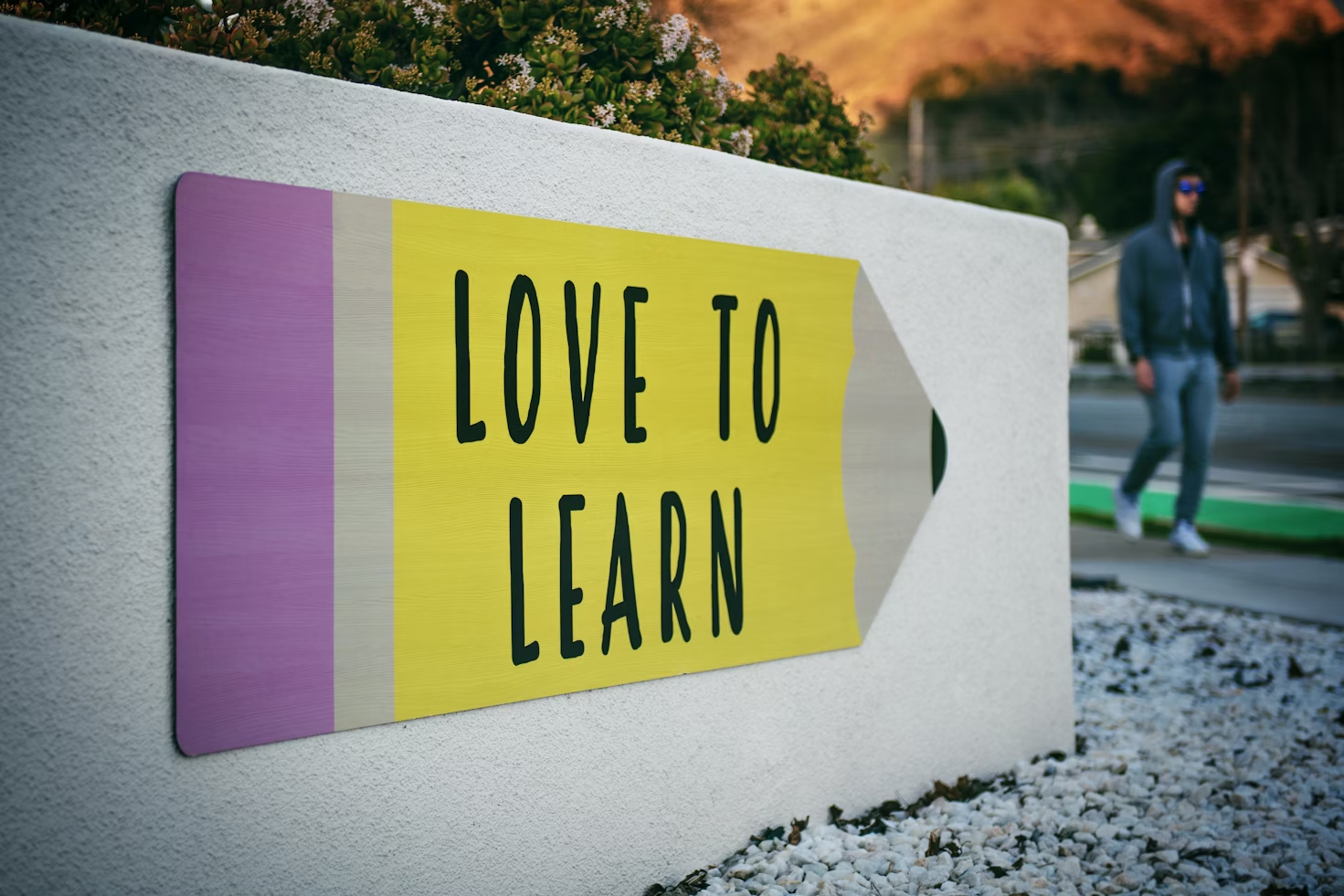
When you’re curious for more, we offer custom courses, which anyone could join. We put together the curricula to match your level and objectives and start learning.
We do our best to have a flexible schedule and most courses will be held online. However, in-person meetings are also available in Bucharest.
How Does This Work?#
There are three tiers we offer, but depending on the topic and your interest, they are flexible and up for discussion — hence the customization.
✅ the essential package, with 5 meetings (approximately 10 hours);
✅ the detailed package, with 10 meetings (approximately 20 hours);
✅ the premium package, which can be added to any of the tier you choose and which gets you the meeting recordings, as well as all the recommended reading materials, the lecturer’s slides and notes for all the meetings.
All packages include free access to a WhatsApp group, for further discussion and sharing.
Courses Portfolio#
We are hard at work for the upcoming portfolio, so this section is a work in progress.
Come by soon or drop us an email for questions or suggestions.
Archive#
Press here to see some of our previous courses. They could be organized again if you're interested, so please drop us an email with the topic you'd like to study!
History and Philosophy of Mathematics or The Set of Real Numbers
We focus on a seemingly simple, but profound topic, which is has a very rich history: the set of real numbers. We will talk about sets, about numbers, and answer questions such as What makes numbers like e or π real?
Find out more here.
Literary Science
When reading novels or any kind of literature, if you focus on the subtle mathematics therein, then you’re ready to meet multidimensional spaces, with trees and graphs and diagrams that get more and more intricate as you’re advancing through the story.
We start with modern and contemporary literary works and invite you to discover the mathematics subtleties that make up the worlds they build.
Find out more here.
On Symmetry: Aesthetics, Mathematics, Natural Science
Symmetry is all around us, everyone has an intuitive understanding of what it is. However, a rigorous definition is not easy to formulate, since the concept feels so basic that everyone knows it, right?
What are the origins of symmetry? Etymology speaks about measurements, but most of us see it as a qualitative feature, not as a number.
How did it become a fundamental concept in science, art, and philosophy?
Find out more here.
Music: Language, Mathematics, Physics
Good music has a message and it speaks to all of us. Hence, it is a language. But it is also one of the most abstract: its words are written with signs that not many of us could actually read, and the message is not always clear.
The rules and patterns that make up scales and patterns are mostly mathematical.
At the same time, music speaks through sounds: air vibrations which are physical waves, hence obey the laws of classical physics.
How do all of these features come together to make what we all know music is? What can we learn from Oliver Sacks and Leonard Bernstein about the role of music in our lives? What does generative music or Euclidean rhythms mean anyway?
Find out more here.
Gamification and Game Design Concepts in Education
Games are really good digital tools for learning, when chosen and studied properly. This is equally true for video games, board games, and the mathematical study of *game theory*.Choose your own adventure and let us guide you through multiple concepts of game design, character design, gameplay, and reward psychology which you can use to boost your learning.
Find out more here.